
Dental pain decision path
An online evaluation can organize urgency, symptoms, health history, and current medicines before a clinician decides what happens next. The broader online dental pain medication access pathway explains where this screening step fits. It never guarantees medication and cannot replace an examination when the cause or severity is uncertain.
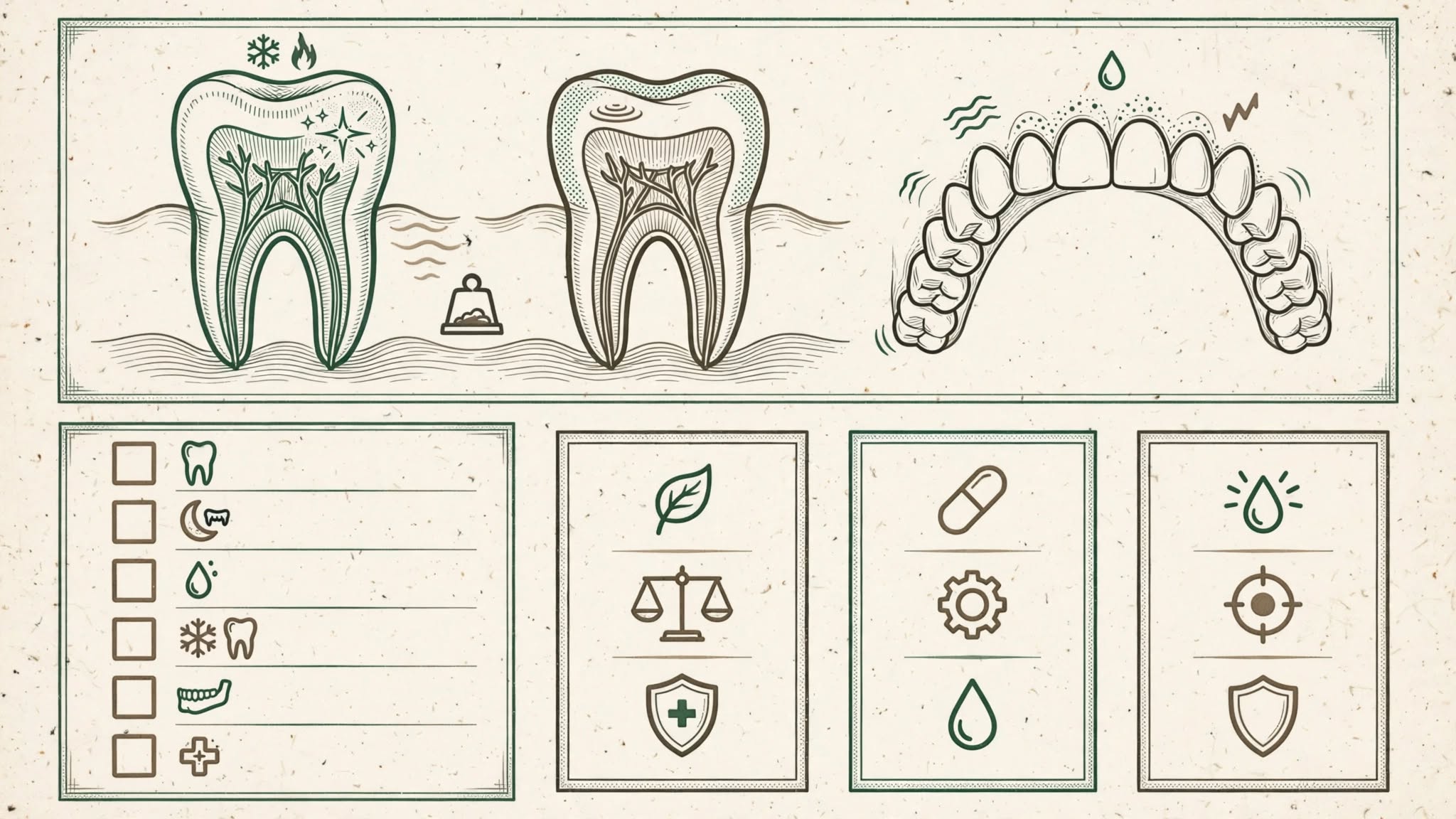
Eligibility starts with the problem, not a preferred medicine
A useful screening process asks what changed, how quickly it changed, whether a dentist has already identified a cause, and whether any warning signs are present. It then checks individual safety factors. Depending on those answers, the appropriate result may be general self-care information, a clinician visit, an urgent dental referral, or emergency care—not a prescription.
The five-check sequence
What a responsible evaluation needs to establish
Dental pain is a symptom, not a diagnosis. A cracked tooth, decay, inflamed dental pulp, gum disease, a recent procedure, infection, or pain referred from another area can feel similar without having the same treatment. These checks keep an online request centered on clinical context rather than the name or perceived strength of a medicine.
-
Screen for urgent warning signs
Report fever, rapidly increasing swelling, swelling of the face or neck, difficulty opening the mouth, drainage, severe weakness, or symptoms that are quickly worsening. Trouble breathing or swallowing, fainting, confusion, or rapidly spreading swelling requires urgent in-person help rather than waiting for an online response.
-
Describe the dental context
Include the location and pattern of pain, when it began, triggers such as biting or temperature, recent dental work, injuries, swelling, and whether a dentist has already examined the area or taken imaging. A remote clinician should know what has and has not been diagnosed.
-
Build a complete health history
Pregnancy, allergies, kidney or liver disease, prior stomach ulcer or bleeding, heart or blood-pressure conditions, asthma reactions, bleeding disorders, and upcoming procedures can change medication safety. Age and other conditions matter too. A short form should not encourage someone to omit details to appear eligible.
-
Reconcile every current product
List prescriptions, nonprescription pain relievers, cold and flu products, supplements, and recently stopped medicines. Brand names alone can hide duplicate ingredients. Blood thinners, aspirin, steroids, some antidepressants, blood-pressure medicines, and another anti-inflammatory drug are examples of information a clinician may need to assess.
-
Choose the next care setting
The final question is whether remote care is clinically appropriate. The answer may be to continue an existing dental plan, arrange a prompt examination, contact the original treating dentist, seek urgent care, or use emergency services. Eligibility for evaluation is not the same as eligibility for a specific medication.
Decision ledger
How common scenarios change the next step
This table is an orientation tool, not a diagnosis. A clinician may reach a different decision after seeing the full history, and new symptoms can change urgency after a form has been submitted.
Swipe sideways to see all columns.
| Situation | What an online screen can clarify | Likely boundary |
|---|---|---|
| Recent dental procedure with a documented plan | Timing, symptom trend, current instructions, medicines already tried, and whether the treating office should be contacted. | Remote follow-up may be possible if the clinician has enough context and no warning sign is present. |
| New toothache with no diagnosis | Urgency, symptom pattern, health history, and the safest route to a dental assessment. | A form cannot inspect a fracture, measure swelling, test the tooth, or provide dental imaging. |
| Facial swelling, fever, drainage, or worsening pain | Whether the reported features need prompt escalation and what information to take to the dental team. | Waiting for medication alone can delay treatment of the underlying dental problem. |
| Trouble breathing or swallowing, or rapidly spreading neck swelling | An online form is not the appropriate care channel. | Seek emergency help now. |
| Possible reaction or serious adverse symptom after medicine | The medication name, timing, amount taken, other products used, and the symptom sequence. | Severe allergic symptoms, fainting, chest pain, stroke signs, vomiting blood, or black stools require urgent medical attention. |
Before submitting
Prepare information that makes the decision safer
Completeness matters more than speed. Exact dates and product labels can help a clinician identify gaps that a general statement such as “I take nothing important” may hide. If a detail is unknown, say that it is unknown instead of estimating.
Have these details ready
- Current symptoms, their location, start date, and whether they are improving or worsening
- Recent dental diagnosis, procedure, imaging, and instructions, if any
- Clear photos only when requested; a photo does not replace an examination
- All allergies and what happened during each prior reaction
- Medical conditions, pregnancy status when relevant, and upcoming procedures
- Names and labels of prescriptions, nonprescription products, and supplements
Avoid these shortcuts
- Do not describe pain intensity as proof that a stronger medicine is needed
- Do not combine products without checking for repeated active ingredients
- Do not use another person’s medicine or an old prescription for a new episode
- Do not hide a condition, medicine, allergy, or recent dose to pass a screen
- Do not treat temporary pain relief as proof that the dental cause has resolved
- Do not wait on an online reply when emergency warning signs appear
Three legitimate outcomes
An evaluation can end without a medication order
A credible service does not make every path look identical. The clinician’s role is to select the next safe action from the available evidence, explain important limits, and redirect care when the remote format is not enough.
Remote plan
When information is sufficient and symptoms are appropriate for remote care, the clinician may provide instructions, arrange follow-up, or consider a medication within applicable clinical and legal requirements.
Dental examination first
A new or unclear problem may need an examination, testing, or imaging before treatment can be selected. That is a valid clinical decision, not a failed form.
Urgent escalation
Warning signs, rapidly changing symptoms, or a serious possible medication reaction may require urgent dental or medical care. The safest step takes priority over convenience.
After clinical eligibility
Separate fulfillment and cost questions from the medical decision
If a clinician determines that medication is appropriate, the next questions concern a legitimate dispensing path and the amount the patient may pay. Those operational checks should not be presented as evidence that a prescription will be issued.
Questions patients ask before an online evaluation
Does completing the form guarantee a prescription?
No. The form gathers information for a clinical decision. A clinician may determine that no medication is appropriate, that the history is incomplete, or that an in-person dental or medical assessment should happen first.
Can an online evaluation identify the cause of tooth pain?
It can organize symptoms and help determine urgency, but it cannot reproduce every part of a dental examination. Testing the tooth, examining the gums and bite, and obtaining imaging may be necessary to distinguish decay, pulp inflammation, a fracture, infection, or another cause.
What should be included in the medication list?
Include prescriptions, nonprescription pain relievers, cold and flu products, supplements, injections, and recently stopped medicines. Use the label name and strength when available, and report when the last amount was taken. This helps identify duplicated ingredients and potential interactions.
What health history is important to disclose?
Share allergies and prior reactions, pregnancy when relevant, kidney or liver conditions, ulcers or bleeding, cardiovascular and blood-pressure history, asthma reactions, bleeding disorders, and upcoming procedures. This is not an exhaustive list; answer every clinical question accurately.
If the pain improves, is a dental visit still necessary?
Improvement does not prove that the cause has resolved. Decay, a fracture, inflamed pulp, or infection may continue even when symptoms temporarily settle. Follow the clinician’s plan and arrange dental assessment when advised or when symptoms recur or worsen.
Clinical and consumer-safety sources
- American Dental Association: Acute Dental Pain Management Guideline, including evidence-based recommendations for temporary management while definitive dental treatment is arranged.
- MedlinePlus: Tooth abscess, including symptoms and reasons prompt dental treatment may be needed.
- FDA BeSafeRx: Locate a State-Licensed Online Pharmacy, including consumer checks for legitimate online pharmacies.
This page provides general dental and medication-safety information. It does not diagnose a dental condition, recommend an individual dose, guarantee eligibility, or replace care from a dentist, physician, pharmacist, or emergency service.

Medically reviewed by
Internal medicine, health services research, and medication safety
Medical review completed